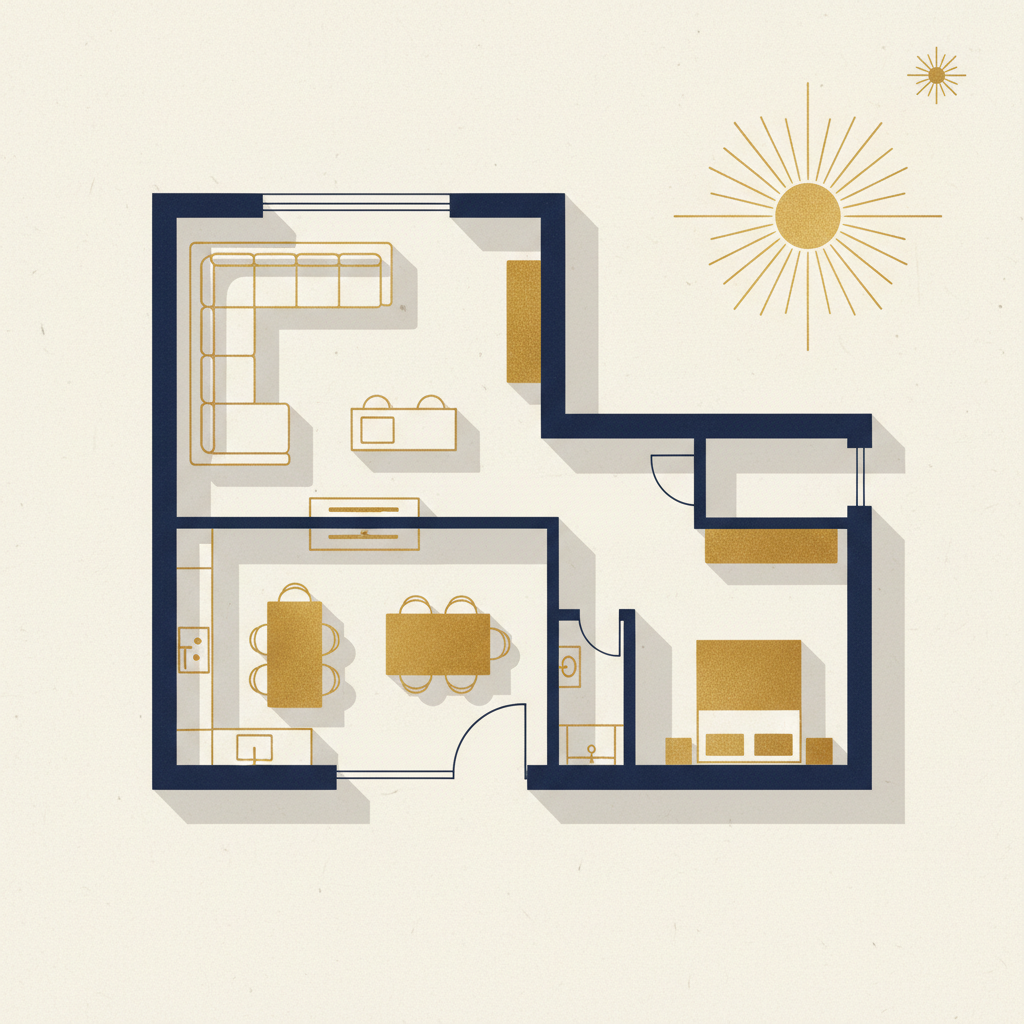
Correct orientation is the foundation of any Vastu-compliant dwelling. If you are wondering how to find vastu directions for home without relying on a digital or magnetic compass, you are returning to the roots of Vedic architecture. Vastu Shastra is fundamentally based on the movement of the sun and the flow of natural forces, meaning the environment itself provides all the cues you need to map your space's energy zones accurately.
The Traditional Method: Using the Rising Sun
The most reliable way to determine your home's orientation is by observing the sunrise. Since the Sun always rises in the East, this serves as your primary reference point. Stand in the center of your plot or main room at dawn and face the sun. The direction directly in front of you is East (Purva), behind you is West (Paschim), your left hand points North (Uttar), and your right hand points South (Dakshin).
How to Find Vastu Directions for Home Using Shadows
If you cannot observe the sunrise, the shadow method—historically known as the Gnomon (Shanku) method in ancient Indian texts—is highly effective. Place a straight stick vertically into the ground on a flat surface. Mark the tip of the shadow in the morning and again in the late afternoon. The line connecting these two points represents the East-West axis, which allows you to derive the four cardinal directions and the crucial diagonal zones like Ishanya (Northeast).
Identifying the Eight Key Vastu Zones
Once you have established the four main directions, you must identify the corner zones where different elements meet. Each zone governs a specific aspect of your life:
- Northeast (Ishanya): The Water element; ideal for meditation and prayer.
- Southeast (Agneya): The Fire element; the best location for the kitchen.
- Southwest (Nairutya): The Earth element; provides stability for the master bedroom.
- Northwest (Vayu): The Air element; suitable for guest rooms and storage.
The Vedic Tradition of Orientation
Ancient Indian temples, such as the Konark Sun Temple, were built with such precision that the first rays of the sun would hit specific points of the sanctum. This wasn't done with modern GPS, but through a deep understanding of solar geometry. By learning how to find vastu directions for home using these same natural principles, you align your living space with the cosmic rhythm that these grand structures have honored for centuries.
Practical Tips for Modern Urban Dwellers
In modern apartments, finding the exact center (Brahmasthan) is key. You can use a printed floor plan to find the geometric center by drawing diagonal lines from the corners. Once you have the center, use the sun’s position through a window to estimate your primary directions. This ensures that your furniture placement and room usage align with the natural flow of energy even in a high-rise building.
Manual methods are excellent for understanding the logic of Vastu, but for pinpoint accuracy in complex modern layouts, technology can help. To ensure every degree of your home is perfectly mapped against Vedic principles, download Vastu Scanner AI and scan your rooms to get an instant, professional direction audit today.